Jekyll Island
How the Federal Reserve was made, from a secret duck hunt to a law, and what the tales add
In November 1910 six men kept it secret that they were going to an island off the coast of Georgia to write a plan for a central bank. In December 1913 President Wilson signed a law that created one.
Nearly every line comes from the Federal Reserve’s own history essays, the text of the Act, its financial statements and the words of those in the room, set beside the scholars, journalists and fact-checkers who tested the tales. The Fed’s account of itself is its account; where critics and the Fed disagree, each gets its say. A banker’s seat at a meeting is a connection, not evidence of wrongdoing, and the tales that need more than that are named as tales.

22 Oct 1907
The run. On 22 October 1907 a New York trust company, Knickerbocker Trust, suspended payments after a run on its deposits. J. P. Morgan had refused it help, because Benjamin Strong of Bankers Trust, sent to look at its books, could not judge in the time available whether it was sound. Morgan then changed his mind and released aid as the runs spread. The Fed’s history says the stock exchange stayed open largely because of him.
30 May 1908
A rich man’s rescue. The 1907 rescue came largely from private bankers, and the Kansas City Fed’s account says Congress concluded the nation could not go on relying on wealthy individuals. The Aldrich-Vreeland Act of 30 May 1908 allowed emergency currency and created an eighteen-member National Monetary Commission under Senator Nelson Aldrich. He hired advisers, among them Henry Davison, a partner at J. P. Morgan, and A. Piatt Andrew, a Harvard economist.
Nov 1910
The duck hunt. In November 1910 Aldrich decided, “most likely at Davison’s suggestion,” to convene a small group, and the two chose the attendees for their expertise. They came one at a time to a train terminal in New Jersey, boarded his private rail car as if for a hunting trip, and used first names only. The Fed’s history says Aldrich knew their ties to Wall Street could arouse suspicion and threaten the bill’s passage. The Kansas City Fed says the meeting was organized by financiers and bankers who thought the public would not welcome a plan crafted in part by bankers.
Nov 1910
The island. The Jekyll Island Club, off the coast of Georgia, was founded in 1886; its members included J. P. Morgan, Marshall Field and William Kissam Vanderbilt. The Fed’s history says a member, most likely Morgan, arranged for the group to use it. The six men who went were Aldrich, his secretary, and four bankers and officials; Morgan was not among them.
Nov 1910
Six men. Aldrich and his secretary Arthur Shelton; Davison of J. P. Morgan & Co.; Andrew of the Treasury; Frank Vanderlip of National City Bank; and Paul Warburg of Kuhn, Loeb. Vanderlip’s autobiography names a seventh, Benjamin Strong of Bankers Trust; the Fed’s history finds no other account that puts him there, though he worked with the group. They agreed on broad principles and fought over details for more than a week.

Jan 1912
What they wrote. One central bank with fifteen branches that would hold the banks’ reserves, issue currency and clear checks, each branch run by a board that the member banks elected, with larger banks getting more votes. Aldrich fell ill, so Vanderlip and Strong went to Washington to get it ready; in January 1911 he gave it to the National Monetary Commission without telling its members how it had been drawn up. The Commission sent it to Congress in 1912 as the National Reserve Association, in a letter calling it “scientific in its method, and democratic in its control.” Committees in both chambers attacked it for giving the government too little control and bankers too much.
Nov 1912
Nineteen twelve. Opposing the Aldrich plan went into the Democrats’ platform. In Dunne’s account the Bryanite wing of the party recoiled in horror, and Glass, of the party’s center, was hostile too. Wilson won with his party holding both houses, and the banking community, which had backed the plan, grew anxious about what would come. That winter a House subcommittee led by Arsène Pujo, with the lawyer Samuel Untermyer as counsel, asked whether a few men controlled the country’s money; its report cites testimony from Vanderlip and Davison.

23 Jun 1913
Public, not private. On 23 June 1913 Wilson went before Congress to say what the new law must do. The banking laws, he said, “must mobilize reserves” and must not permit the country’s monetary resources to be concentrated in a few hands, or used for speculation in such volume as to hinder other uses. And control of the system “must be public, not private, must be vested in the Government itself,” so that the banks would be “the instruments, not the masters” of business.
1913
Two bills. Glass, who led the House subcommittee, wanted separate regional banks and no central board, and his plan, like Aldrich’s, gave most authority to bankers, the Kansas City Fed says. Wilson wanted an oversight board. On the other flank, in Dunne’s account, Bryanite Democrats on the House committee pressed a bill of their own for a gigantic issue of greenbacks; Bryan, whose power could block any monetary measure, agreed once Reserve Bank notes were made obligations of the government as well as the banks, and later wrote to his followers to stand by the President. In the Senate, Robert Owen’s bill prevailed, limiting the Reserve Banks to twelve.
23 Dec 1913
The twenty-third of December. The law made a Federal Reserve Board entirely of presidential appointees, some ex officio because of their cabinet positions and the rest appointed for specific terms. To give bankers a voice, it added a Federal Advisory Council of twelve bankers elected by the regional banks, which would meet the Board occasionally. Terms for governors were set at ten years, staggered, to ensure no president could appoint all of them in two terms.
1916
A mere yarn. The journalist B. C. Forbes wrote about the island trip in 1916. Few noticed, and those who did dismissed it as “a mere yarn,” according to Aldrich’s biographer. The participants denied the meeting for twenty years, until Aldrich’s biography in 1930. Warburg wrote that year that Aldrich had pledged all participants to secrecy. The Fed’s history gives a likely spur for coming clean: Carter Glass’s 1927 memoir, which claimed the Act’s key ideas as his own.
1927
Whose act? Glass, by then a senator, claimed the Act’s key ideas as his own. Edwin Seligman of Columbia had written in 1914, in his introduction to Warburg’s essays, that the Act was “the work of Mr. Warburg more than of any other man,” and he and Glass argued the point in the Times in 1927. Samuel Untermyer called Glass’s claim “fiction”; a Times headline of June 1927 says he claimed the glory for Owen, with Wilson, McAdoo and Bryan also entitled to credit. The Fed’s history is plural: the ideas of Glass, Owen, Wilson’s advisers and Warburg together formed the basis of the Act, whose details closely resembled the Aldrich plan and whose major differences were in who decides.
2026
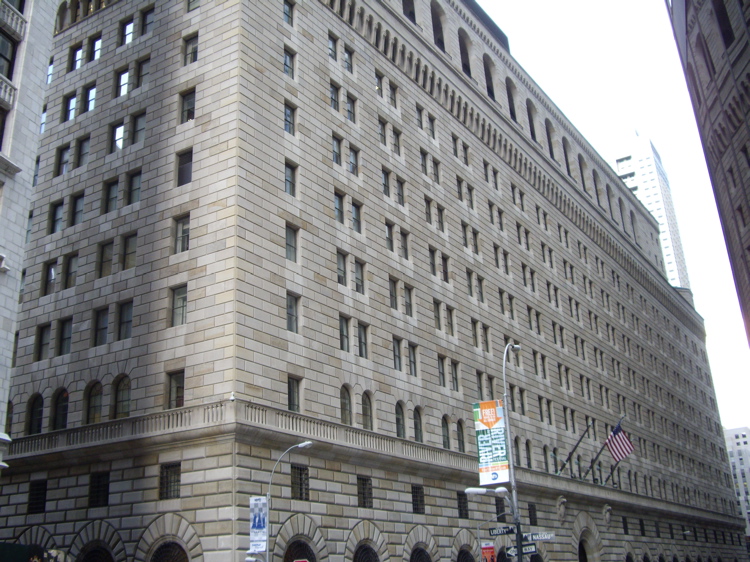
Who runs it. By the Act as it stands, the President appoints the Board of Governors and the Senate confirms them. Each of the twelve Reserve Banks has nine directors: three of class A, chosen by and representing the member banks; three of class B, who represent the public and may not be officers, directors or employees of any bank; and three of class C, named by the Board. The member banks vote on classes A and B, and a Reserve Bank’s president is chosen by classes B and C with the Board’s approval. On policy, the Board’s governors and the New York Reserve Bank’s president always vote, and four other Bank presidents vote in rotation. A GAO report of October 2011 on Reserve Bank governance was titled “Opportunities Exist to Broaden Director Recruitment Efforts and Increase Transparency.”
2026
Who owns it. The Fed says it “is not ‘owned’ by anyone,” and that “some observers mistakenly consider” it private because the Reserve Banks are organized like corporations. The law backs part of each view: member banks hold the stock, which “shall not be transferred or hypothecated”; they vote for six of nine directors; dividends are capped, at 6 percent, or for banks with assets above about $10 billion the lesser of 6 percent and the ten-year Treasury yield. A list in a 1983 chapter newsletter named a set of banks as the Fed’s owners; the ADL checked it against the New York Fed’s member banks and found that all but one were not members.

2021
What it pays. The Reserve Banks pay their costs and their dividends, keep a capped surplus, and by law send the rest to the Treasury. In 2021 that was $109,025 million, in 2020 $86,890 million. It does not always happen: in weeks when earnings fall below costs, dividends and the surplus, the Reserve Banks suspend payments and book a deferred asset. At the end of 2024, in the latest statements used here, that stood at $215,955 million, which future earnings must cover before payments resume.
2026
Audited, but how far. The Fed says the Reserve Banks’ statements are audited every year by an outside firm hired by the Board, the Board’s by an outside auditor hired by its inspector general, and that the Government Accountability Office reviews it often. The law separately limits what the GAO may audit: under 31 U.S.C. 714(b), the Comptroller General’s audits may not include monetary-policy decisions, dealings with foreign central banks and governments, or Open Market Committee transactions. Subsections (e) and (f) open exceptions: the GAO may audit emergency lending under section 13(3), and discount-window and open-market “covered transactions,” for operational integrity, accounting, internal controls and collateral policies, but not for policy.
25 Jul 2012
The audit fight. Ron Paul introduced the Federal Reserve Transparency Act (H.R. 459) in January 2011 to require more comprehensive GAO audits. In June 2012 the House Oversight Committee advanced it on a voice vote, with Dennis Kucinich among those speaking for it; on 25 July the House passed it 327 to 98. The Fed’s reply is that Congress structured it so its policy decisions “do not become subject to political pressures that could lead to undesirable outcomes.” Separately, the GAO reported in July 2011 on the emergency lending, which the Fed says found no conflicts of interest or material weaknesses, though the report’s title says opportunities exist to strengthen policies. The sources saved here do not say what became of H.R. 459 after the House vote.
15 Apr 1912
The ship. An internet tale says J. P. Morgan arranged the sinking of the Titanic to kill three men who opposed the Federal Reserve. Snopes rated it False and found the meme shared since at least 2014; Lead Stories finds it in circulation in 2012, calls it an antisemitic conspiracy theory, and quotes one version whose aim is “the Rothschild ponzi scheme.” The one real seed is that Morgan was booked on the voyage and cancelled, History.com and Reuters say. Reuters adds that historians debate why, and that the Titanic researcher George Behe says it was not “mere hours” before departure, as the meme has it.
23 Dec 1913
The test. Morgan died on 31 March 1913, nine months before the Act was signed on 23 December, and what stood before Congress in April 1912 was Aldrich’s plan. Reuters, citing a Washington Post investigation, says Astor and Guggenheim took no public stance, while Straus reportedly spoke in favor; Lead Stories adds a letter from Straus to the Times of 25 October 1911. Snopes’s summary says the Times reported Astor in favor, but the only 1911 Times item in its list of sources is about Straus. The historian J. Kent Layton told Snopes that all three men were seen during the sinking, and that a plot to kill them could not have ensured they died.
1952
Where it came from. The meeting was real and secret, and the Fed’s own history tells it; the sources saved here do not say how the tales grew from it. The ADL dates the written attacks it cites to 1931, with A. N. Field, the 1950s, with Wickliffe Vennard, and Eustace Mullins, whose 1952 book, the Woodrow Wilson Presidential Library says, Mullins “took it very much in the direction of hatred against bankers and Jews.” The ADL prints a passage in which Mullins names Paul Warburg and two other men as architects of the monetary system and labels each by religion and descent; it calls the claim that Jews control the Fed a classic antisemitic myth. This story names the men on the island by what they did, in the jobs they held.
Pictures, from Wikimedia Commons: New York City, Fred Hsu on en.wikipedia, CC BY-SA 4.0; U.S. Congress, Martin Falbisoner, CC BY-SA 3.0; Washington, D.C., Carol M. Highsmith, Public domain; Federal Reserve Bank of New York, Dmadeo, CC BY-SA 3.0; U.S. Treasury, 颐园居, CC BY-SA 4.0.


Something wrong or missing? Tell us, with a source, or edit this page.