Ninety-Five Theses
How a Wittenberg teacher's objections to the sale of indulgences travelled by printing press to Worms, to a Bible in German, and to a Europe of divided churches
In 1517 a theology lecturer at the University of Wittenberg wrote ninety-five propositions about the sale of indulgences. Within five years he had been condemned by a pope, heard by an emperor, and had put the New Testament into German.
From Clay to Print ended with a press at Mainz and, at its last stop, a Bible in German printed at Wittenberg. This story goes back to find how that Bible came to be.
Each side is given in its own words, and the story does not say which was right. Where the sources disagree, as they do on whether the theses were nailed to a door, each account is given and credited. Luther’s later writings on the Jews are part of the record and are reported plainly, with the later words of the Lutheran church that bears his name.
1517
A teacher in Wittenberg. In 1517 Martin Luther was an Augustinian friar and a lecturer in theology at the University of Wittenberg, in Saxony. Elector Frederick had founded it in 1502. Looking back, Luther called himself then “a preacher, a young (so to speak) doctor of theology.” He wrote a list of propositions for a university debate.
1517
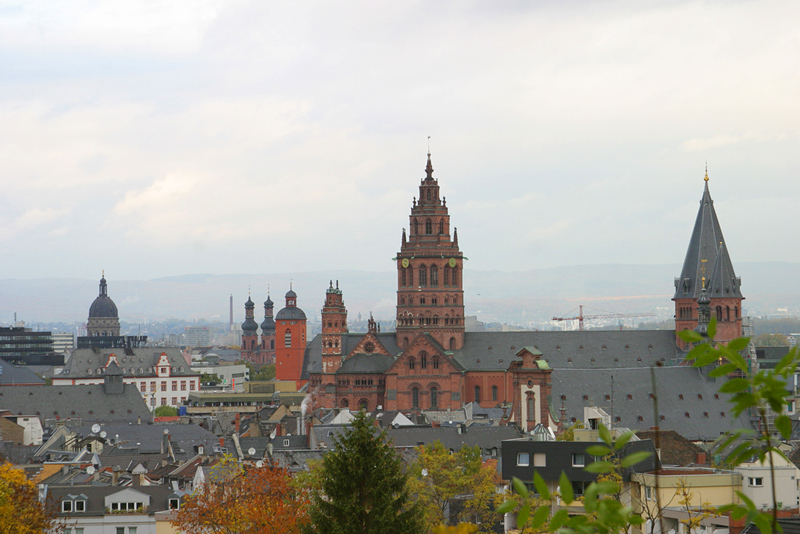
A sale for a church. In 1515 Pope Leo X granted an indulgence for the building of St. Peter’s in Rome, to run eight years. In Germany it was preached under the name of Archbishop Albert of Mainz. The German Historical Institute’s editors say Albert recruited the preacher to pay off debts to the Fugger bank. Luther later wrote that Albert received half of the money and the pope the other half.
1517
The preacher. Johann Tetzel, a Dominican friar, preached the indulgence for Albert in 1517. Banned from Saxony, he came as near as Jüterbog, and people from Wittenberg went there to buy it. The Church itself taught that forgiveness needs contrition, the German Historical Institute’s editors note, but many people could not tell the grace from the fee.
31 Oct 1517
Ninety-five propositions. The Latin sheet invites a debate at Wittenberg and asks those who cannot come to write. It says preachers are in error who claim the pope’s indulgences free a man from every penalty (thesis 21), and that giving to the poor is a better work than buying pardons (43). It does not turn from the pope: thesis 71 reads, “He who speaks against the truth of apostolic pardons, let him be anathema and accursed!”
31 Oct 1517
Nailed to a door? The famous picture comes from Philip Melanchthon, who wrote in 1546, the year Luther died, that Luther posted the propositions on the church by the castle on the eve of All Saints. Melanchthon came to Wittenberg only in August 1518. Luther’s secretary Georg Rörer also wrote that theses were posted, and Wittenberg’s university rules called for debate theses to be posted on the doors of the town’s churches.
31 Oct 1517
Or sent by letter? Luther’s own later accounts speak of letters to Archbishop Albert and to the bishop of Brandenburg, and of a printed sheet for debate. None mentions a door. The church historian Erwin Iserloh argued in the 1960s that the posting never happened. In 2015 two historians who disagree, Timothy Wengert and Volker Leppin, wrote that there are “equally good arguments for and against.” This story does not choose.
Mar 1518
Far beyond my expectation. Luther sent the propositions to friends, and friends carried them to the presses. By the end of 1517 copies were reprinted at Nuremberg and Basel, and friends in Nuremberg had them put into German. Looking back in 1541, Luther said they went through the whole of Germany in two weeks. Then he wrote the Sermon on Indulgence and Grace in German, which had more than twenty reprints.
14 Feb 1519
The presses. At Basel the printer Johann Froben, who had published Erasmus’s Greek New Testament in 1516, wrote to Luther in February 1519 that he had sent copies to France and Spain and sold out all but ten. Luther moved the printing of his Explanations of the theses to Melchior Lotter at Leipzig because the first printer’s edition was so full of errors. By 1525, the Pitts Theology Library says, Luther was by far the most published author since the invention of the press.
14 Oct 1518
Before the legate. Rome summoned Luther to answer for heresy, but at his request, and with the emperor’s help, the hearing was moved to Augsburg. The pope’s brief told Cardinal Cajetan to bring Luther before him, and to receive him kindly if he repented. Luther reported that the legate would hear only “I recant,” and that they clashed over whether indulgences are the treasury of Christ’s merits. He drew up an appeal.
27 Jun 1519
Leipzig. In June 1519 the duke of Saxony gave a hall in his Leipzig castle for a public debate. Johann Eck argued first with Karlstadt on free will, then with Luther on whether Rome’s rank above other churches rests only on recent papal decrees. Mosellanus, who spoke at the opening, wrote that they debated nearly twenty days and that Eck pressed Luther on the Hussite articles. Each side called itself the winner.
15 Jun 1520
The pope’s answer. On 15 June 1520 Pope Leo X signed Exsurge Domine. It listed statements of Luther’s as errors, among them that the Church’s treasures are not the merits of Christ and the saints, and gave him sixty days to recant. Eck and Cajetan sat on the commission that drafted it. On 10 December Luther threw the bull into a fire outside Wittenberg’s walls, with books of church law.
18 Apr 1521
Worms. On 18 April 1521, with the emperor’s safe-conduct, Luther stood before Charles V and the estates of the Empire. The spokesman asked whether he would recant what he had written against the Church’s tradition and its councils. Luther asked to be shown his error from Scripture or evident reason, and said he trusted neither popes nor councils alone. The words “Here I stand” are not in the record printed here.
May 1521
The emperor’s answer. The next morning Charles V read a statement he had written himself: his forebears had defended the Catholic faith, and so would he. In May the Edict of Worms put Luther under the ban. No one was to “buy, sell, read, preserve, copy, print” his books. The Venetian envoy Gaspar Contarini noted on 26 April that they were already sold openly at Worms.
18 Dec 1521
The Wartburg. On the road home on 4 May, masked riders seized Luther and took him to the elector’s castle near Eisenach, where he stayed hidden until March 1522. He signed his letters from “Patmos” and “the wilderness.” In December he warned Albert of Mainz about what he called an idol set up again at Halle, and Albert answered in his own hand: “I can well bear fraternal and Christian punishment.”
Sep 1522
A Testament in German. In September 1522 the New Testament appeared in German. Luther worked from the Greek text Erasmus had edited, not only from the Latin, and revised it at Wittenberg with Melanchthon. Between 3,000 and 5,000 copies were printed, a second edition was needed by December, and the price was one guilder, two months of a schoolmaster’s pay, the Gruber collection says.

1534
Back to the press. In 1534 the whole Bible appeared in German at Wittenberg, printed by Hans Lufft. Eighty years earlier Gutenberg had printed Jerome’s Latin at Mainz, the story told in From Clay to Print. By 1534 Luther’s New Testament had had 87 editions in High German and about 19 in Low German. The German Historical Institute’s editors say the press carried the Luther Bible across the German-speaking lands.
25 Jun 1530
Two Protestant churches. In 1529 Luther, Zwingli and eight others signed fifteen articles at Marburg. The last records that they could not agree on how Christ is present in communion, and pledges them to love. The split eventually led to a Lutheran and a Reformed confession, the Institute’s editors write. In 1530 the Lutheran princes and cities laid the Augsburg Confession before Charles V, and the diet ended without agreement.
1543
Luther on the Jews. In 1523 Luther wrote that Christians should deal gently with Jews: “So long as we thus treat them like dogs, how can we expect to work any good among them?” In 1543, in On the Jews and Their Lies, he advised seven steps, the first the burning of synagogues and the second the razing of Jewish houses; the Lutheran scholar Gerhard Forde calls the treatise appalling. In 1994 the Evangelical Lutheran Church in America wrote that it rejects this “violent invective” and deplores its use by modern anti-Semites.
25 Sep 1555
A peace, of a kind. After two wars, the Diet of Augsburg in 1555 let the Empire’s rulers hold either the old religion or the Augsburg Confession. A ruler could require his subjects to follow his religion or leave. Anyone of a third confession was “altogether excluded.” The Peace was meant to hold only until Christian unity was restored.

4 Dec 1563
Trent. The Catholic Church answered at the Council of Trent, which met between 1547 and 1563. Its last session on 4 December 1563 taught that Christ gave the Church the power to grant indulgences and ordered them kept. It also ordered every “evil gain” connected with them abolished. The Church kept the teaching and ordered an end to the paid trade; on the rest the churches stayed apart.
Pictures, from Wikimedia Commons: Mainz, Martin Bahmann, CC BY-SA 3.0; Luther Bible, Torsten Schleese, Public domain; Catholic Church, Jebulon, CC0.


Something wrong or missing? Tell us, with a source, or edit this page.