The Oil Weapon
How a war in October 1973 became an embargo, a price shock, and lines at American gas stations
In October 1973 a war in the Middle East ended with an embargo on oil to the United States. By January 1974 the price of a barrel had nearly quadrupled, and in the winter that followed Americans queued at gas stations.
Nearly every line here comes from the State Department’s published record of the time: cables, memos, and transcripts of telephone calls, with the Federal Reserve’s history, the statutes, and the organizations’ own pages beside them. Where governments gave different accounts of the war and its causes, the story gives each its own words and does not pick one.
10 Sep 1960
Baghdad, 1960. In September 1960 five oil-producing countries met in Baghdad and created the Organization of the Petroleum Exporting Countries: Iran, Iraq, Kuwait, Saudi Arabia and Venezuela. In OPEC’s own telling, the world market was then dominated by seven big multinational companies, known as the Seven Sisters. Four of them come into this story.

1973
Who ran Aramco. In Saudi Arabia the oil came up through the Arabian American Oil Company, Aramco. The State Department’s glossary lists its owners as four U.S. companies: Socal 30 percent, Texaco 30, Esso 30 and Mobil 10. Three of the four, Esso (Exxon), Socal (Chevron) and Mobil, descend from the pieces of Standard Oil that the Supreme Court split up in 1911, as told in The Trust.
Feb 1971
Tehran and Tripoli, 1971. In early 1971 the oil companies planned to put their proposals to OPEC states separately in Tehran and in Tripoli. By August a State Department note judged that OPEC had won “large tax increases in oil exports under threat of a shutdown in production.” Its members, the note added, were now weighing a campaign for partial control of the companies’ producing subsidiaries.
24 Apr 1973
A friend asks for help. On 24 April 1973 King Faisal wrote to Nixon. Saudi policy, he said, was “to cooperate fully with the United States by producing as much oil as we can,” and he did not expect the U.S. to drop its commitments to Israel. But he asked for something to show other Arabs. After the embargo began, a U.S. report of Yamani’s words says Saudi Arabia had given this message repeatedly over six months or a year.
6 Oct 1973
6 October. Egypt and Syria attacked Israeli forces in the Sinai and on the Golan Heights. The day before, Prime Minister Golda Meir had told Kissinger that Israel had no intention of striking first, and that if Syria or Egypt began an offensive Israel “will react militarily, with firmness and in great strength.” On 7 October Egypt’s adviser Hafiz Ismail wrote that Egypt had answered “Israeli provocations,” and asked that Israel “withdraw from all occupied territories.”

14 Oct 1973
The airlift. By 9 October, after a failed counter-attack, the Israelis asked America to resupply them, and Nixon agreed. American planes began landing in Israel on 14 October. The State Department’s history adds that the Soviets had begun resupplying Egypt and Syria first.

12 Oct 1973
A warning from the owners. On 12 October the chairmen of Exxon, Mobil, Texaco and Standard Oil of California sent the White House a note. They called OPEC’s demand for a price rise of about 100 percent “unacceptable,” and warned of what more aid to Israel could do. A notation shows Nixon saw Kissinger’s summary of it on 3 November.
17 Oct 1973
Kuwait, 17 October. Arab oil ministers announced an immediate cut in output of 5 percent, with a further 5 percent each month until Israel withdrew to its 1967 lines and the Palestinians’ “legal rights” were restored. In the same week six Persian Gulf members of OPEC raised their price by 70 percent, from $3.01 to $5.12 a barrel.
20 Oct 1973
The embargo. On 19 October Nixon asked Congress for $2.2 billion to pay for the equipment sent to Israel. The same day Libya announced a cut-off of oil to the U.S., and on 20 October Saudi Arabia announced it would stop all its exports to the United States. A CIA paper that week judged the effect on the U.S. “would be relatively small”; Kissinger told his staff on 23 October, “We will break it.” Prince Fahd wrote that the embargo would last until Israel left the land it took in 1967, in a message the U.S. record says King Faisal did not specifically know of.
20 Oct 1973
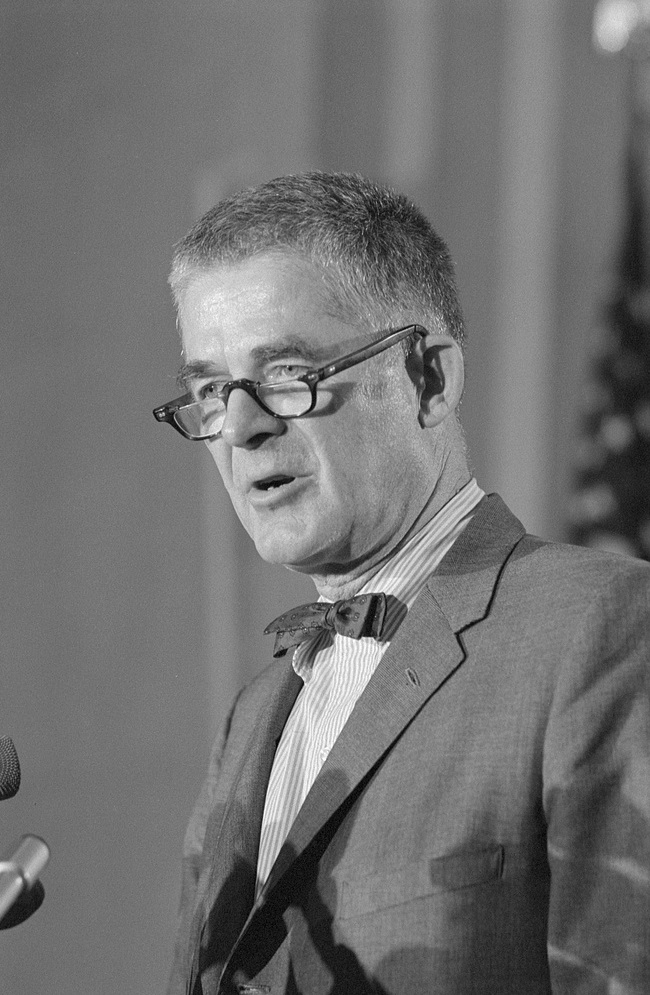
The same Saturday. 20 October 1973 was also the day of the Saturday Night Massacre. Nixon ordered the Watergate special prosecutor, Archibald Cox, dismissed; the Attorney General and his deputy resigned, and Solicitor General Robert Bork carried it out. On 6 November Deputy Defense Secretary William Clements told a White House meeting that “the naming of a new Attorney General and a new prosecutor are side issues” next to the energy crisis. The Plumbers tells the Watergate side.
7 Nov 1973
Project Independence. On 7 November, from the Oval Office, Nixon told the country: “We are heading toward the most acute shortages of energy since World War II.” He asked for lower thermostats, fewer flights and, from the governors, speed limits of 50 miles an hour, and he set a goal of meeting U.S. energy needs from U.S. sources by 1980. He ended on Watergate: “I have no intention whatever of walking away from the job I was elected to do.”
4 Dec 1973
The lines. On 25 November Nixon announced that all gas stations would close from 9 p.m. Saturday to midnight Sunday. On 4 December he named William Simon to run a new Federal Energy Office. In February he told Saudi Arabia’s ambassador about the “lines at gas stations,” and twelve days later told the Egyptian and Saudi foreign ministers: “you have seen the cars lined up at the gas stations.”
23 Dec 1973
The price doubles again. On 22 and 23 December the Persian Gulf members of OPEC met in Tehran and doubled their prices. The Shah, a U.S. ambassador reported, said: “I cannot get less for my oil than other countries.” Saudi officials told a U.S. diplomat that Saudi Arabia had “strongly opposed” the rise. The Federal Reserve’s history gives the whole move as $2.90 before the embargo and $11.65 in January 1974.
2 Jan 1974
Fifty-five. On 7 November Nixon had asked the governors for 50 miles an hour and said that alone could save over 200,000 barrels of oil a day. He also asked Congress for power to cut speed limits nationwide. The Emergency Highway Energy Conservation Act, approved on 2 January 1974, barred federal approval of highway projects in any state with a limit above 55.
18 Jan 1974
The shuttle. On 11 January 1974 Kissinger flew to Aswan, where Sadat was working, and spent a week flying between Egypt and Israel. The first disengagement agreement was reached on 18 January. On 27 January Sadat wrote to Nixon that, after a visit by his envoy, King Faisal had agreed to lift the embargo.

11 Feb 1974
Washington, February 1974. The U.S. brought the foreign ministers of twelve oil-importing countries to the State Department. Kissinger asked for cooperation among all nations. In his own account France’s foreign minister would not pledge an outcome in advance, and a French official told the U.S. Embassy that the French saw the U.S. as trying “either to dominate Europe or break up the Community.”

18 Mar 1974
18 March 1974. Arab oil ministers meeting in Vienna decided to lift the embargo on the United States, with a review set for 1 June. The Federal Reserve’s history says it ended “amid disagreements within OAPEC on how long to continue the punishment”; the State Department’s names the prospect of an Israeli-Syrian settlement. That day Nixon asked Kissinger when they would know. The higher prices stayed.

18 Nov 1974
Oil buyers unite. Kissinger had asked for a coordinating group at the February conference, and the consuming countries’ Energy Coordinating Group met in Brussels in September. On 18 November 1974 the Agreement on an International Energy Program was signed, and the International Energy Agency began work. By then Nixon had resigned, on 9 August, and Gerald Ford was President.
22 Dec 1975
A reserve underground. Gerald Ford signed the Energy Policy and Conservation Act on 22 December 1975. It set a policy of a Strategic Petroleum Reserve of up to 1 billion barrels. Ford later called the law “an inadequate measure.”

Feb 1953
Kuwait’s savings. The meeting that announced the cut was in Kuwait, a state that had begun investing its oil surplus twenty years earlier. By its own account it set up the Kuwait Investment Board in London in 1953. Today the Kuwait Investment Authority, acting for the Government of Kuwait, appears in BlackRock’s 2026 proxy statement with 5.14 percent of the company; Who Owns BlackRock and Vanguard tells that story.
Pictures, from Wikimedia Commons: ExxonMobil, Michael Martin from Cypress, Texas, CC BY-SA 2.0; Richard Nixon, Department of Defense. Department of the Army. Office of the Deputy Chief of Staff for Ope, Public domain; Chevron, InvadingInvader, CC BY-SA 4.0; Archibald Cox, Warren K. Leffler, Public domain; Washington, D.C., Carol M. Highsmith, Public domain; Vienna, Andrzej Otrębski, CC BY-SA 4.0; Gerald R. Ford, David Hume Kennerly, Public domain; BlackRock, Dazzling4, CC BY-SA 4.0.
Something wrong or missing? Tell us, with a source, or edit this page.


