The Trust
How one Cleveland refiner came to control American oil, why the country broke it up, and what became of the pieces
In 1870 Standard Oil was one refiner among many in Cleveland. In 1911 the Supreme Court ordered it broken up.
Nearly every line here comes from court opinions, sworn testimony, government reports, and the books of those who fought over the company, its founder’s among them. Where counts differ, the story says who counted. The case for the company and the case against each get their say, and the story does not pick one.

1870
Cleveland. The world wanted kerosene for its lamps, and refiners were crowding in. Rockefeller’s savings joined with the still of Samuel Andrews, who “had been a day laborer in refineries, and so poor that his wife took in sewing.” In January 1870 they became the Standard Oil Company. It was one of about 26 refiners in Cleveland alone.

26 Feb 1872
A secret deal. A small group signed contracts with the railroads as the South Improvement Company. To New York, the open rate on crude was $2.56 a barrel. The group would get $1.06 back. It would get the same again on every barrel its rivals shipped. Rockefeller was a director. On 26 February 1872 the rates leaked out: nearly double for everyone else.

Mar 1872
Three months. One Cleveland refiner swore that unless they joined, “we were virtually killed as refiners.” Rockefeller answered in 1909: “It has been said that I forced the men who became my partners in the oil business to join with me. I would not have been so short-sighted.”

28 Mar 1872
The Oil War. In the oil country of Pennsylvania, producers rose up. “A wonderful row followed,” remembered a girl who lived there, Ida Tarbell. On 28 March 1872 the railroads annulled their contracts, and the state repealed the company’s charter. The scheme was dead. The Cleveland refineries stayed sold.

1882
The eel. By 1882 some fifty people with stakes in companies of different states had put their stock in the hands of nine trustees, for trust certificates. The companies ran as one. Yet the thing itself, Tarbell wrote, “signed no contracts, kept no books. It had no legal existence.”

1906
How much of it. The counts differ, so here is who counted. John Archbold of the company testified to about 10 per cent of U.S. refining in 1870 and probably 75 per cent in 1888. A history of Cleveland says 90 per cent ten years after 1872. The government’s suit said 90 per cent.
Mar 1881
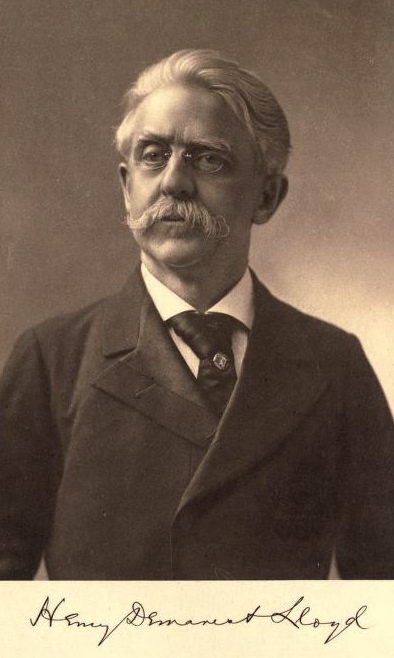
The first alarm. Henry Demarest Lloyd’s article made the company known to the country. His book of 1894 ended on a warning: “Monopoly is business at the end of its journey. It has got there.” A New York Senate committee called the trust “the type of a system which has spread like a disease through the commercial system of this country.”

1880
The company’s answer. Rockefeller swore that “the average price to consumers of refined oil has been lower than for years previous.” A railroad officer swore that denying a big shipper its low rate would hurt “the consumers, who in the end pay the transportation charges.”

2 Jul 1890
A law. On 2 July 1890 Congress passed “An act to protect trade and commerce against unlawful restraints.” Its first section named the trust. The sentence ends: illegal.

2 Mar 1892
A fifty-cent book. Ohio’s attorney general stopped at a Columbus book shop and picked up a small yellow volume called “Trusts.” At the end he found the trust agreement, the first time he had seen it. Ohio sued and won in 1892. In 1899 the business moved into a holding company, Standard Oil of New Jersey.

1904
The record. Decades of investigations had left a public paper trail, and Ida Tarbell read it. Her father said: “Don’t do it, Ida—they will ruin the magazine.” She described the work as “neither apologists nor critics, only journalists.” Her history of the company came out in 1904.

3 Aug 1907
The fine. In 1906 President Roosevelt sent Congress a Bureau of Corporations report on how oil moved. Company officials had told the Bureau they got no rebate. Then a jury found Standard Oil of Indiana guilty on 1,462 counts: the published rate from Whiting was 18 cents per 100 pounds, and it had paid 6.

1911
Broken up. The record ran to about 12,000 pages. In 1911 the Supreme Court upheld the breakup, and gave the company six months instead of thirty days. Chief Justice Edward White read the Sherman Act by a “standard of reason”: not every restraint of trade, only unreasonable ones.

1911
One objection. Justice Harlan agreed that the company had broken the law. His quarrel was with the reasoning. The act said every contract in restraint of trade. Earlier, he wrote, the Court had declined to insert “the word ‘unreasonable’” into it: that would be “judicial legislation.”

1 Dec 1998
The pieces. Standard Oil of New Jersey became Exxon in 1972. Standard Oil of New York merged with Vacuum Oil, and in 1966 that company became Mobil. Standard Oil of California became Chevron in 1984. Eighty-seven years after the Court split them, the first two agreed to be one company.
1958
The case for. The economist John McGee went back through the trial record. “Standard Oil was not born with monopoly power,” he wrote. Rockefeller said prices “decreased as the efficiency of the business has been built up.” Even the Ohio court allowed: “It may be true that it has improved the quality and cheapened the costs.”
1892
The case against. The same court went on. Cheap oil, it wrote, “is not one of the usual or general results of a monopoly,” and the law looks at “what usually happens.” Tarbell’s record held the rest: a secret rate, and cash paid on every barrel a rival shipped.

1913
The giving. He helped build the University of Chicago, and set up the Rockefeller Institute for Medical Research, the General Education Board, and in 1913 a foundation “to promote the well-being of mankind throughout the world.” The best philanthropy, he wrote, is “an attempt to cure evils at their source.”
Pictures, from Wikimedia Commons: Standard Oil, Unknown, Public domain; John D. Rockefeller, Unknown, Public domain; Cleveland, Erik Drost, CC BY 4.0; Titusville, Pennsylvania, VitaleBaby at English Wikipedia, Public domain; Henry Flagler, Unknown authorUnknown author, Public domain; John D. Archbold, Wilson, James Grant, 1832-1914; Fiske, John, 1842-1901; Dick, Charles, 1858-; Homans, Jame, Public domain; Henry Demarest Lloyd, E.H. Purdy, Boston, 1903, Public domain; Kerosene, Burger, Public domain; U.S. Congress, Martin Falbisoner, CC BY-SA 3.0; Supreme Court of Ohio, Sixflashphoto, CC BY-SA 4.0; Ida Tarbell, James E. Purdy / Adam Cuerden, Public domain; Kenesaw Mountain Landis, Bain News Service, publisher, Public domain; U.S. Supreme Court, UpstateNYer, CC BY-SA 3.0; John Marshall Harlan, Mathew Brady or Levin Handy, Public domain; ExxonMobil, Michael Martin from Cypress, Texas, CC BY-SA 2.0; Rockefeller Foundation, Peter Guo, CC BY-SA 2.0.


Something wrong or missing? Tell us, with a source, or edit this page.